Thermal transmittance Uw: understanding the numbers behind thermal performance
Uw, Ug, Uf: what these values actually mean and why they always depend on the specific configuration.
June 13, 2026 / 4 min read
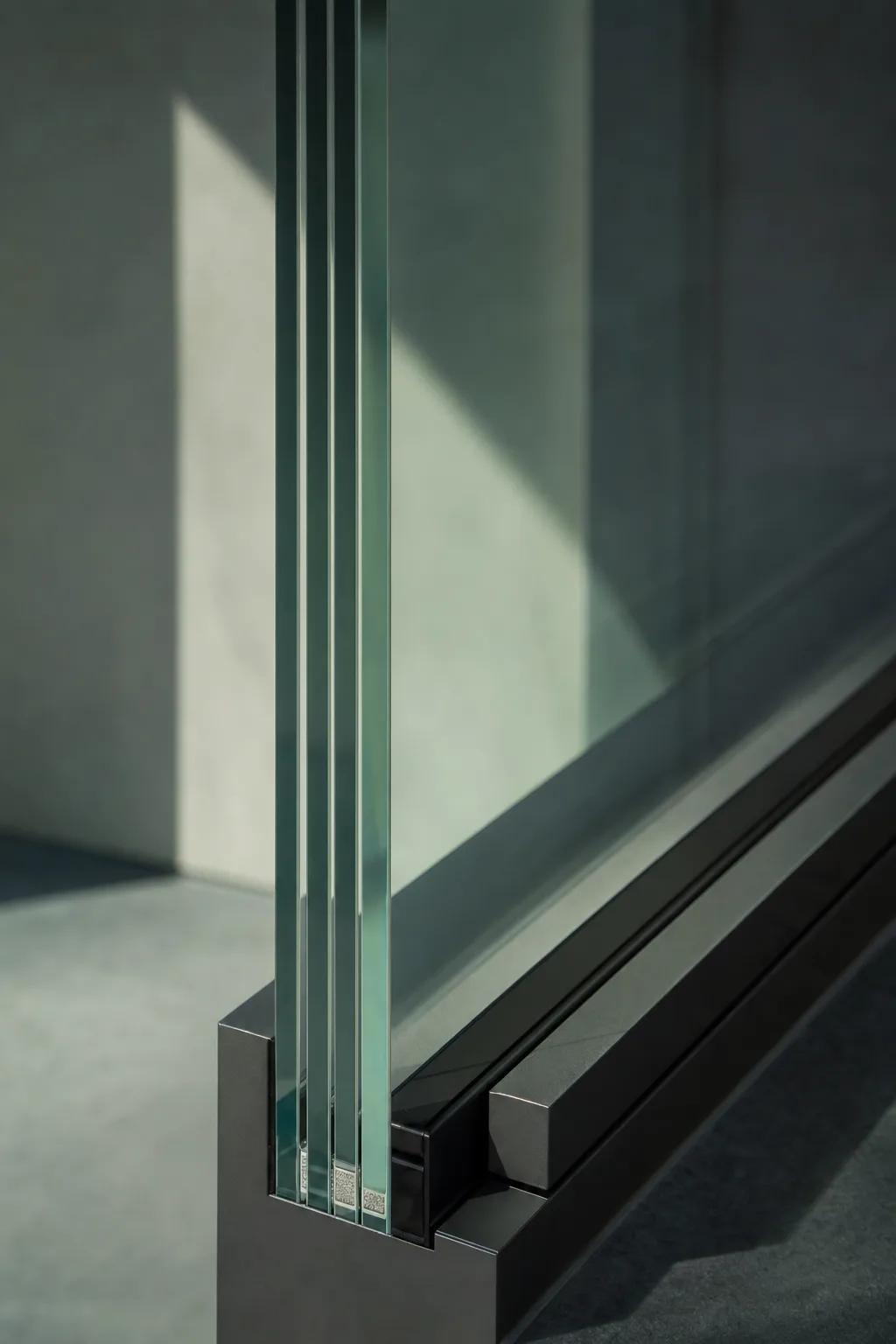
Uw, Ug, Uf: what these values actually mean and why they always depend on the specific configuration.
June 13, 2026 / 4 min read
When discussing the thermal performance of a window system, the number that appears most frequently is thermal transmittance, expressed as Uw. It is a synthetic value — convenient for comparison, easy to communicate — but also easy to misread if the underlying logic is not understood. Grasping how it works is the first step towards making informed decisions, whether at the design stage or at the point of purchase.
Thermal transmittance measures the quantity of heat that passes through a surface per square metre, per degree of temperature difference between the two sides, per unit of time. In plain terms: how much heat "travels" through the window system. The lower the value, the better the insulation. Values are expressed in W/m²K — watts per square metre per kelvin.
The overall Uw value of a window system is the result of three distinct contributions. The first is the transmittance of the glass, expressed as Ug: this describes the thermal performance of the insulating glass unit independently of the frame that holds it. The second is the transmittance of the frame, expressed as Uf: this describes how much heat passes through the aluminium, timber or composite profiles of the system. The third is a correction term accounting for the perimeter of the glass, where frame and glazing meet and where the risk of thermal bridging is highest.
The resulting Uw value depends on the proportion of these contributions: a system with excellent glazing but a poorly performing frame may deliver a worse Uw than expected, and vice versa. Panel dimensions have a significant influence: large openings have a lower ratio of frame to total area, which tends to improve the overall Uw. Smaller openings reverse this relationship.
This dependence on geometry is precisely why the Uw values quoted in catalogues and technical data sheets are always configuration examples, not universal figures. Change the dimensions or the glass specification, and the Uw changes. In the PURASISTEMI Battente system configuration examples, a single-sash window measuring 1000×1500 mm with Ug 0.5 glazing achieves a Uw of 0.94 W/m²K. With different dimensions or different glass, the result shifts accordingly.
This clarification is not a way of avoiding comparison: it is a technical requirement. Comparing Uw values across different systems is meaningful only when calculation conditions are the same — same dimensions, same glass, same calculation method. Without this uniformity, comparisons frequently lead to misleading conclusions.
The Uw value determined in laboratory conditions describes the product's performance under standardised parameters. The real in-situ performance also depends on how the system is installed: the quality of the technical joint, the treatment of the junction between frame and wall, and the continuity of insulation around the subframe. A poorly qualified installation can undermine the performance of a technically excellent product by creating localised thermal bridges that the declared Uw value cannot describe.
Discussing thermal transmittance honestly means consistently noting that the number refers to the product, not to the installation. Real performance is the result of the complete system: window, installation, subframe, technical joint and envelope continuity. This is why the choice of installer and the quality of workmanship is an integral part of performance evaluation, not a separate downstream step.
European energy performance regulations are progressively orienting the industry towards more demanding performance standards. The European Energy Performance of Buildings Directive — the so-called Green Homes Directive — requires the gradual reduction of energy consumption across the European building stock and sets increasingly stringent performance requirements for major renovation interventions. These requirements vary according to climatic zone and the nature of the work, and make the ability to read and compare declared values with genuine understanding increasingly important.
At PURASISTEMI, performance values are verified and cited as configuration examples, with calculation conditions stated explicitly. This reflects a deliberate commitment to transparency: offering figures that can genuinely be used in design practice, rather than promotional numbers stripped of context. Explore the system's performance data at purasistemi.com.
PURASISTEMI is a Fasal Lab brand
Via delle industrie 8
30020 Eraclea
Venice - Italy
commerciale@purasistemi.comwww.purasistemi.comFollow us:
InstagramFasal Lab srl - IT 04725180279
Privacy PolicyWebsite Design: Factory42 - Development: MOBA Digital Studio