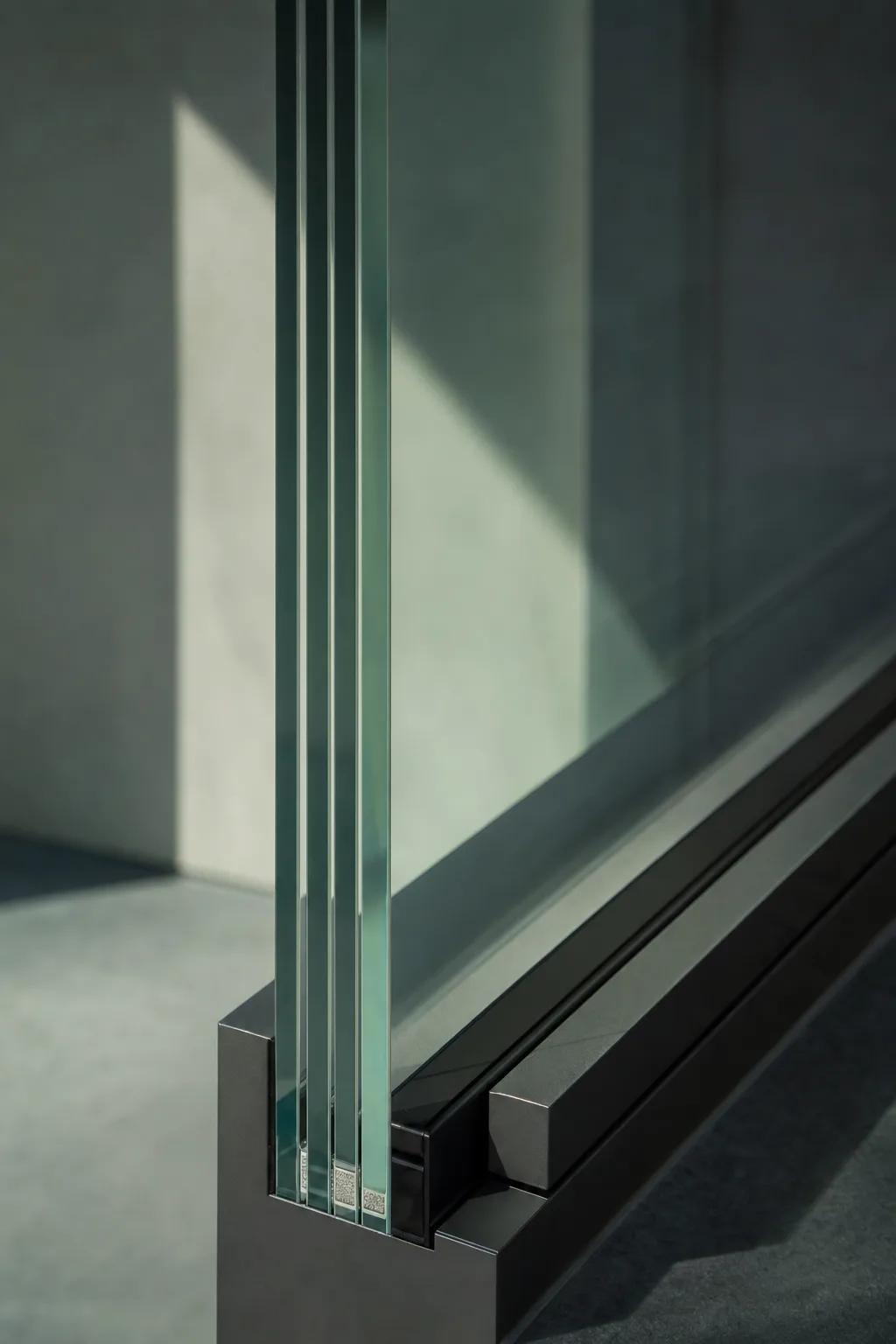
Glass is the most visible part of a window. It is also, frequently, the least understood. We tend to assess it in visual terms — clarity, reflectivity, tint — and rarely look beyond the distinction between double and triple glazing. Yet within a modern insulating glass unit lies a significant share of the system's overall performance: thermal insulation, summer behaviour, light quality, reduction of the cold surface effect. Understanding how an advanced insulating glass unit is constructed is the first step toward an informed choice.
Low-emissivity coating: selective glass, not neutral glass
A standard float glass pane transmits both visible light and infrared radiation freely. In a window without further treatment, this means continuous heat loss to the exterior during cold months. A low-emissivity coating — applied to the inner surface of the pane facing the air gap — changes this behaviour substantially. It reflects infrared radiation emitted by warm interior surfaces back into the room, reducing thermal dispersal without significantly affecting the transmission of natural light.
Modern low-emissivity coatings are formulated to optimise this balance: strong thermal performance, good light transmission, and a solar factor that can be calibrated to orientation and climate. Not all coatings are equivalent, and the appropriate choice depends on building orientation, latitude, and whether heating or cooling loads predominate. In any case, a low-emissivity coating is now considered standard in quality insulating glass units.
The warm edge spacer: the detail that matters at the margins
The most thermally vulnerable point of an insulating glass unit is not the centre of the pane: it is the edge. The spacer — the profile that separates the panes and maintains the air or gas cavity — was traditionally made from aluminium, a highly conductive material. The result was a localised thermal bridge running around the perimeter of the window, responsible for condensation, mould formation at corners, and a measurable reduction in overall performance.
Warm edge spacers are made from low-conductivity materials — special steels, composite profiles, or technical polymers — and substantially reduce this perimeter thermal bridge. The benefit is twofold: overall thermal transmittance of the glazing unit improves, and the risk of interior surface condensation along the edges is reduced, which matters both for hygiene and for the visual quality of the installation. The growing adoption of warm edge spacers in premium glazing units is one of the clearest trends in the window sector in recent years.
Structural bonding: the glazing unit as a rigid system
In a traditional window, the insulating glass unit is held in place by a glazing bead — a supplementary visible profile that creates a clear visual break between glass and frame. Structural bonding of the glass unit to the frame eliminates the glazing bead entirely, replacing mechanical retention with a perimeter structural adhesive bond. The result is a rigid, monolithic frame-glass unit in which stresses distribute evenly across the assembly.
The advantages are multiple. Aesthetically, the continuity between glass and frame is complete: no additional profiles, no visual interruptions, a clean surface that integrates perfectly with the language of minimal design. In performance terms, structural bonding increases the rigidity of the entire sash, improves resistance to wind loads, and contributes to overall acoustic insulation. It is a technology borrowed from the automotive and aerospace industries, applied to the window sector with results that translate into quality that can be felt and seen over time.
The combination of these three elements — low-emissivity coating, warm edge spacer, and structural bonding — defines the difference between a glass unit that meets minimum requirements and one that genuinely elevates the overall quality of the window system.
- Low-emissivity coating: reduces thermal dispersal, maintains high light transmission
- Warm edge spacer: eliminates the perimeter thermal bridge, reduces edge condensation
- Structural bonding: rigid frame-glass unit, continuous aesthetics, greater resistance and insulation
In PURASISTEMI systems, the insulating glass unit is an integral part of the design: triple glazing with structural bonding, slender profiles, and light transmission of up to 74% — as a configuration example; actual results depend on system, glass specification, and sash dimensions. To explore available configurations, visit purasistemi.com.